Gen AI vs Agentic AI: Understanding the Paradigm Shift
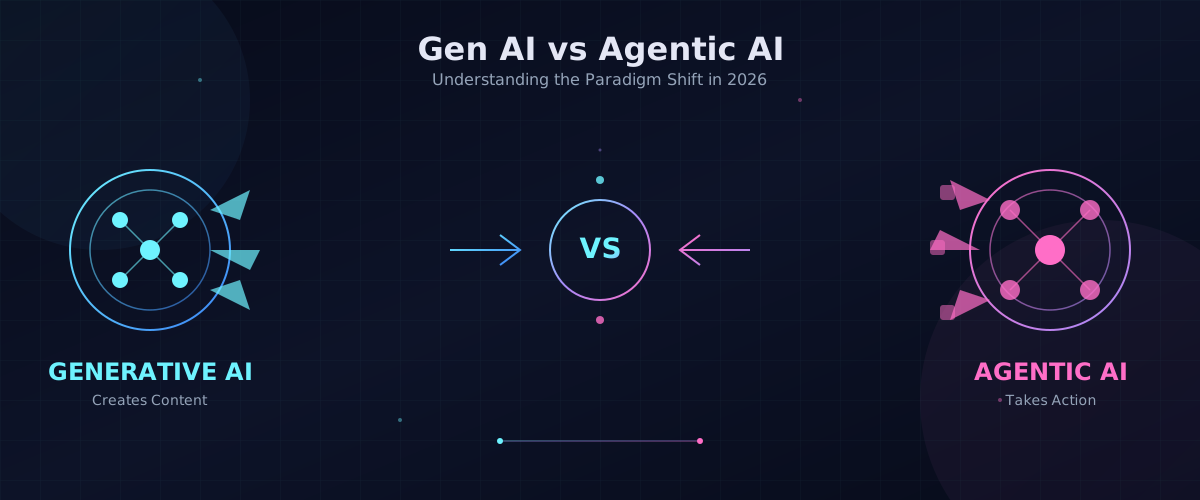
Generative AI creates content. Agentic AI takes action. Understanding this distinction is crucial for building the next generation of intelligent systems that deliver real business value.
The fundamental distinction
The AI landscape in 2026 is defined by two distinct paradigms: Generative AI and Agentic AI. While they share foundational technologies, their capabilities, architectures, and use cases diverge significantly. Understanding this distinction is essential for architects, developers, and business leaders making strategic technology decisions.
Key Insight
Generative AI answers "What should I say?" while Agentic AI answers "What should I do?" This shift from passive content creation to active task execution represents the most significant evolution in AI applications since the introduction of transformers.
Core definitions
G Generative AI
Systems designed to create new content based on learned patterns from training data. These models generate text, images, code, audio, and video in response to prompts.
- Produces human-like content
- Operates in request-response mode
- No persistent state or memory
- Cannot execute external actions
- Examples: GPT-4, Claude, DALL-E, Midjourney
A Agentic AI
Autonomous systems that can perceive, reason, plan, and execute actions to achieve goals. These agents operate with varying degrees of independence and can interact with external systems.
- Takes autonomous actions
- Plans multi-step workflows
- Maintains memory and state
- Integrates with tools and APIs
- Examples: AutoGPT, BabyAGI, LangChain Agents
Architectural differences
The architectural patterns underlying these two paradigms reflect their fundamentally different objectives. Generative AI prioritizes output quality and coherence, while Agentic AI emphasizes goal achievement and environmental interaction.
| Aspect | Generative AI | Agentic AI |
|---|---|---|
| Core Function | Content generation | Goal-oriented action |
| Input Processing | Prompt parsing | Environment perception + goal interpretation |
| Output Type | Text, images, code, media | Actions, decisions, tool calls |
| State Management | Stateless (per request) | Stateful (persistent memory) |
| External Integration | Minimal (via plugins) | Native (tools, APIs, databases) |
| Decision Making | Pattern completion | Planning and reasoning |
| Autonomy Level | None (human-initiated) | Variable (configurable) |
| Error Handling | Regeneration | Retry, replan, escalate |
The Agentic AI stack
Modern agentic systems are built on four interconnected layers that enable autonomous operation. Each layer is designed to be observable, auditable, and independently upgradeable.
Perception Layer
Multimodal encoders and vector stores that ground the agent in real-time data from dashboards, documents, and external APIs.
Reasoning Layer
LLM-powered planners that decompose goals into executable steps, handle dependencies, and manage execution flow.
Action Layer
Verified tool adapters that execute plans with guardrails, including API calls, database operations, and file manipulations.
Memory Layer
Persistent storage for conversation history, learned preferences, and contextual knowledge across sessions.
When to use each approach
Choosing between Generative AI and Agentic AI depends on your specific use case, risk tolerance, and infrastructure maturity. Neither approach is universally superior; each excels in different contexts.
Use Generative AI when:
You need content creation, summarization, translation, or creative assistance. The output is consumed directly by humans who can verify quality. Examples include writing assistants, code completion, image generation, and document analysis.
Use Agentic AI when:
You need autonomous task execution, workflow orchestration, or multi-step processes. The system must interact with external tools, make decisions, and handle failures gracefully. Examples include automated customer support, data pipeline management, and research automation.
Hybrid approaches work best when:
You need both content generation and action execution. Many production systems use Generative AI for content creation within an Agentic framework for orchestration. This combines the creative capabilities of LLMs with the execution power of autonomous agents.
Start simple, then evolve:
Begin with Generative AI to validate use cases and user needs. As requirements mature and you identify repetitive workflows, incrementally add agentic capabilities. This staged approach reduces risk and builds organizational confidence.
Real-world applications
Both paradigms have proven their value across industries. Understanding where each excels helps organizations make informed architectural decisions.
Content Production
Gen AI excels at marketing copy, technical documentation, creative writing, and personalized communications at scale.
Customer Support
Agentic AI resolves tickets end-to-end by accessing systems, processing returns, and escalating complex issues to humans.
Code Generation
Gen AI accelerates development with code completion, documentation, and refactoring suggestions in real-time.
DevOps Automation
Agentic AI monitors infrastructure, responds to incidents, scales resources, and performs routine maintenance autonomously.
Research Assistance
Gen AI summarizes papers, explains concepts, and generates hypotheses based on existing literature.
Data Analysis
Agentic AI queries databases, generates reports, identifies anomalies, and triggers alerts without human intervention.
Challenges and considerations
"The transition from Gen AI to Agentic AI isn't just technical; it's a fundamental shift in how we think about AI responsibility, oversight, and trust."
- Gen AI challenges: Hallucinations, bias in training data, copyright concerns, and quality consistency at scale require robust validation pipelines.
- Agentic AI challenges: Action safety, goal misalignment, unexpected behaviors, and the need for comprehensive observability demand careful governance frameworks.
- Shared concerns: Data privacy, model drift, computational costs, and regulatory compliance apply to both paradigms and require ongoing attention.
- Mitigation strategies: Implement human-in-the-loop review, establish clear escalation paths, maintain detailed audit logs, and regularly test edge cases.
The convergence future
The boundary between Generative and Agentic AI is blurring. Modern systems increasingly combine both capabilities: Generative AI for content creation within Agentic frameworks for execution and orchestration. This convergence is driving the next wave of AI applications.
2026 Trend
Leading AI platforms now offer unified APIs that seamlessly blend generation and action. GPT-5's native tool-calling, Claude's extended thinking with artifacts, and open-source frameworks like LangChain represent this convergence. The future belongs to systems that can both think and act.
Unified Interfaces
Single APIs that handle both content generation and tool execution, simplifying development while maintaining flexibility.
Adaptive Autonomy
Systems that dynamically adjust their autonomy level based on task complexity, confidence, and risk assessment.
Explainable Actions
Built-in reasoning traces that show why agents chose specific actions, enabling trust and debugging.
Implementation roadmap
Organizations should adopt a staged approach when transitioning from Generative to Agentic AI. This progression builds confidence, establishes governance, and minimizes risk.
Phase 1: Foundation
Deploy Gen AI for content tasks. Establish usage policies, monitor quality, and build internal expertise with prompt engineering.
Phase 2: Integration
Add tool calling capabilities. Start with read-only operations like data retrieval and analysis before enabling write actions.
Phase 3: Autonomy
Deploy autonomous agents for well-defined workflows. Maintain human oversight and clear escalation procedures.
Phase 4: Scale
Expand agent deployment across use cases. Standardize tools, share prompt libraries, and build internal agent marketplaces.
Ready to build intelligent systems?
Start with clear use cases, instrument everything, and iterate based on real-world feedback. The organizations winning with AI in 2026 treat it as a capability to be developed, not a product to be purchased.
Explore more AI insights